Head line: Mainland China chain restaurants and tea shops taking over Hong Kong’s streets (Assignment of Reporting and Writing, 2024-5-6)
Core Question: Will the Mainland restaurant enterprises that expanded their business to Hong Kong be able to continue operating in the long term?
Dozens of people formed a line stretching in front of Bank Centre Mall in Mong Kok in mid-December last year to get a taste of ice cream and tea from MIXUE’s first Hong Kong store, as beverage chains from across the border flock to the city for IPOs.
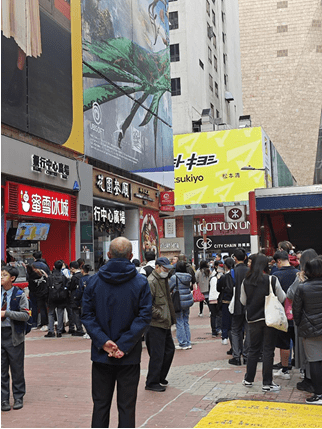
(MIXUE’s opening, 2023-12-17, Mong Kok, Ku Man Chun)
MIXUE is the biggest milk tea shop in Mainland China, with more than 36,000 stores worldwide source? MIXUE is known for freshly-made fruit drinks, tea drinks, ice cream, and coffee at affordable prices. For example, on MIXUE’s menu fresh ice cream” goes for $HK5, Ice Lemonade for 9 HKD, and Coffee Americano for 11 HKD.
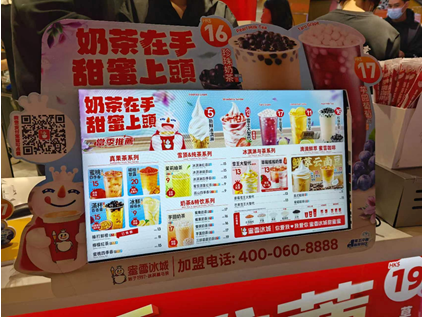
MIXUE has sold about 5.8 billion cups of drinks in 12 countries including China in the first nine months of 2023. (MIXUE’s website https://www.mxbc.com/store)
(MIXUE’s Menu, 2023-12-17, Mong Kok, Ku Man Chun)
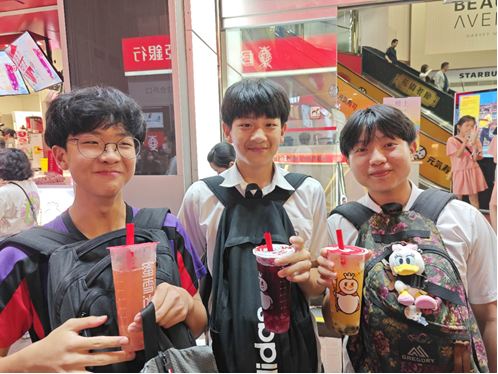
“I saw a lot of people lining up here, so I want to try as well,” said 16-year-old student Lau Pak Yin about MIXUE Mong Kok, which had taken over the branch of a Hong Kong outlet of bakery chain, Saint Honore Cake Shop.
Giant chain restaurant enterprises from mainland China like MIXUE are expanding their business to Hong Kong. According to the business database WinShang, in 2023 17 restaurant enterprises opened their first branch in Hong Kong. Among the 17 brands, 9 of them sell drinks including lemon tea, milk tea, coffee, and yogurt. MIXUE is one of them, opening its first store on 17 December 2023 and the second in May 2024.
The chain restaurants are flocking to Hong Kong as they eye IPOs on the city’s stock market. MIXUE has submitted IPO application. (HKEX) According to IFR(International Financial Review), MIXUE aims to raise 1 billion USD.
Listing on the Hong Kong stock exchange can give mainland tea chains and their owners access to larger capital to grow their brands. “Tianren’s Tea successfully went public, and its owner’s wealth increased rapidly in a short amount of time. A lot of people want to copy its success. That’s why they come to Hong Kong.” Professor Ko said. (Professor of Practice (Marketing), PolyU)
One tea shop chain from the mainland, CHABAIDAO, has just been listed in HKEX. By looking into CHABAIDAO and the other two milk tea chain’s stocks at HKEX (1750,2150,2555), we can see that all three of their stock price show a consistent downward trend after their listing. So, how do the listed companies raise capital?
“Suppose you own a company and trade 50% equity for 500 million by offering 50 million shares at 10 dollars each. If the agent sells all shares, how much do they earn?” Said Professor Ko. Eventually, you will receive 500 million cash. Through an IPO, business owners can exchange their company’s equity for a significant amount of cash.
However, the chain tea stores gave other explanations for the reason of coming to Hong Kong.
“Hong Kong provides a suitable cultural atmosphere and business environment for us, also the best bridge for us to the world.” Gao Yun, the representative of SHUYI, known for milk tea with diverse toppings. SHUYI has just opened its first branch at Mong Kok East Station in April this year.
“In 2023, SHUYI opened stores in Malaysia, Vietnam, Thailand, and America.” Said Gao Yun. There is no news about SHUYI going public yet, but it has started expanding into overseas markets.
According to the official websites and records on HK restaurant guide OpenRice, LINLEE (Lemon tea shop) has 7 stores, Yuan Ji Yun Dumpling has 13, and HeyTea has 6 in Hong Kong. The business model may be the reason for their quick expansion. All of these brands adopt franchising models. According to MIXUE’s application proof for IPO, most of the revenue was generated under its franchise model from sales of goods and equipment to franchised stores.
“Let’s take 7-11 as an example. If you want to start a 7-11 store, for my permission of trademark, you need to pay me a membership fee,rent a store, source goods from me, and submit part of your profit to me.” Said Professor Ko “In this case, the franchisee is the one who dies, franchisors always earn money.”
So, how is the franchisee doing? Do the consumers’ like MIXUE? On March 14th and May 4th, months after the opening of MIXUE Mong Kok, there are still consumers lining up in front of the counter.

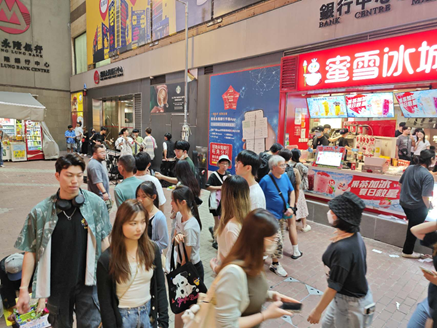
(MIXUE in 2024-3-14, Mong Kok, Ku Man Chun)
(2024-5-3, Mong Kok, Ku Man Chun)
However, the line is significantly shorter, and he major attraction of MIXUE to consumers appears to be its low price. “I am thirsty, and it’s cheap.” said Steven Cheung, a 40-year-old Hong Konger, who was eating an ice cream from MIXUE. His view was echoed by Heve Ng, a 16-year-old student who just got her drink from the counter.. “Considering its price, the taste is decent,” Said Ng.
The price of MIXUE is very cheap compared with other local stores in Hong Kong. An ice cream from MIXUE is $5, compared to a similar ice cream from Mobile Softee which cost $13.
“The cost of chain restaurant enterprises is very low since they have central kitchens,” said Professor Ko. According to MIXUE’s website, to maintain the concept of “high quality at affordable prices,” MIXUE built its raw material production factories, providing franchisees with approximately 60% of the beverage ingredients produced in-house.
Also, MIXUE established its own warehousing and logistics system, to deliver the material to franchisees, capable of covering all stores in China. “The cost-effectiveness is high, I have consumed for three times” said Yuki Mak, a 14-year-old student, when chilling with her friends.
Although being cheaper compared to competitors in Hong Kong, not everyone recognizes MIXUE as cheap. “I can get the same product from MIXUE in mainland China for just ¥9-8, while it cost $15 here.” Said Chloe Lin, a 21-year-old tourist from the mainland, drinking tea.
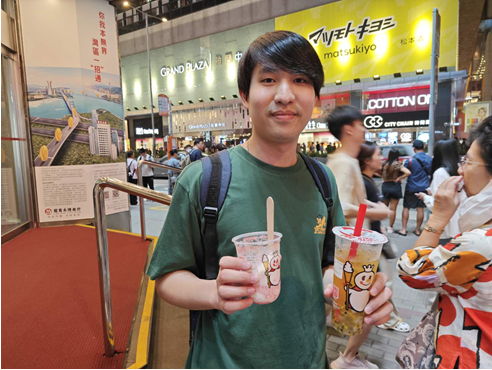
“It’s cheaper than Hong Kong stores, but not the ones in Thailand, they taste the same tho.” Said Arm Chainat, a 29-year-old engineer from Thailand, sharing drinks with his family members.
(Arm Chainat. 2024-5-3, Mong Kok, Ku Man Chun)
For some consumers, MIXUE does not show attractiveness. “I will not try, because I don’t trust its quality.” Said Lau Chi Yau, a 21-year-old student listening to a busker.
Professor Ko is not optimistic about these chains too.
“If all these kinds of stocks are falling after the first date of IPO, then they are all bad stocks. The owner just wants to make money by himself.” Said Professor Ko when summarizing the performance of milk tea brands’ stock. (1750,2150,2555)
However, even though the line is not as long, at 10:30 pm on May 5, still a few people in line, wanting an ice cream or a cup drink from MIXUE.
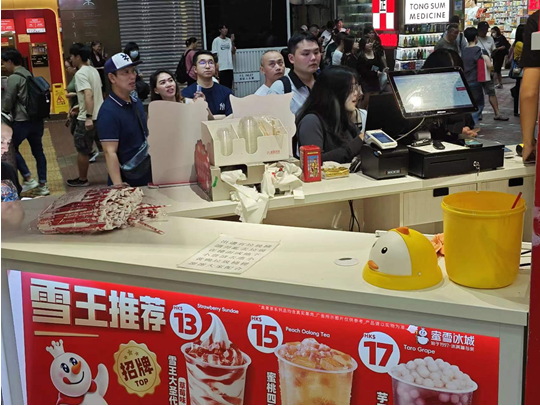
(MIXUE 10:30pm, 2024-5-5, Mong Kok, Ku Man Chun)
“It’s always crowded.” Said Liang Qi Lin, an 18-year-old staff of MIXUE Mong Kok, when he ended his work at 10:40 pm, stepping out from the counter.
“Now there is only one store in Hong Kong, the new store in Causwaybay isn’t functioning yet, people can only come here. There may be fewer people during weekdays, but once it’s weekends or public holidays like today, it’s crowded again.”
What I am proud of:
I really tried my best on interviewing different sources for this story, customers, scholar, staffs, and representative of enterprises.
I also put a lot of effort into gathering information.
What I am not that proud of:
My topic is “chain restaurants and tea shops”. I used this phrase because both restaurants and tea shops are in the same industry. However, I did not get a chance to get in touch with the chain restaurants that recently came to Hong Kong after contacting them.
 Previous Works