Independent investigations and exclusive written reports
Zong Qinghou’s Handwritten Trust Instructions Revealed for the First Time! Hong Kong High Court Continues to Freeze $1.8 Billion in Assets
Original link (In Chinese): https://m.21jingji.com/article/20250801/herald/1de0797a75fe6eda0f40d832c5ea2c10.html
Southern Finance All Media Group Zhang Weize Hong Kong Report
2025-08-01 22:46
21st Century Business Herald Reporter: Zhang Weize Zhu Yiyi Intern: Wang Yizhi Ku Man Chun Hong Kong Report
On August 1, the Hong Kong High Court approved the asset preservation request by the plaintiffs (Zong Jichang, Zong Jieli, and Zong Jisheng) in the Zong Qinghou estate dispute case, imposing restrictions on the assets in the HSBC bank accounts involved in the case (approximately $1.8 billion). The injunction will remain in effect until there is a final ruling in the litigation at the Hangzhou Intermediate People’s Court and the Zhejiang High People’s Court.
According to the judgment obtained by 21st Century Business Herald reporters from the Hong Kong High Court, the Hong Kong High Court ruled that in the Zong Qinghou estate dispute case, the defendant Kelly Zong must pay the plaintiffs (Zong Jichang, Zong Jieli, and Zong Jisheng) all relevant costs related to the original writ and interim summons. The plaintiffs must submit and serve a statement of costs within 3 days after the costs order takes effect, and the defendant may submit and serve a list of objections within 7 days thereafter.
Wu Shuna, operations director of the Delin Family Office, told 21st Century Business Herald reporters that this Hong Kong High Court judgment is only a ruling on the plaintiffs’ application for an asset freezing order, which is a temporary relief measure in the litigation process. This measure aims to prevent the defendant from disposing of or transferring the relevant assets during the litigation, ensuring that subsequent possible judgments can be effectively enforced. This measure does not directly make a final determination on the substantive issues of the case, but provides safeguards for further hearings and possible enforcement of the case.
Wu Shuna further stated that the content of the judgment mainly revolves around whether to grant the asset freezing order. The judge explicitly pointed out in the judgment that there is a “serious dispute” in the case, which requires further hearing. This means that the court has not yet made a final determination on the rights and obligations between the plaintiffs and the defendant, and the substantive issues of the case (such as the legality of the establishment of the trust, whether the defendant violated trust obligations, etc.) still need to be thoroughly reviewed and adjudicated in subsequent litigation procedures. Therefore, from a procedural perspective, the plaintiffs have not yet ultimately prevailed, and the final judgment of the case has not been made.
Details Revealed
In the judgment, details about the Zong Qinghou estate dispute case also surfaced in the judgment.
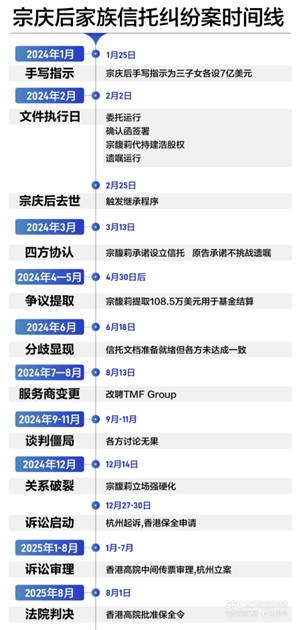
(21 reporters organized a timeline based on the content of the judgment Figure: Li Xuting )
21st Century Business Herald reporters organized a timeline chart based on the content of the judgment
According to the evidence provided by the plaintiffs in the judgment, the “2.1 billion trust” mentioned in the case had already begun to be arranged in 2024. The plaintiffs provided a handwritten instruction from Zong Qinghou, which mentioned instructing Guo Hong to go to HSBC in Hong Kong to handle three trusts, each with $700 million, requiring that the trust principal not be used, and only the interest be collected and used. The plaintiffs claimed that this instruction was personally written by Zong Qinghou in late January 2024.
According to the judgment published by the court, Zong Qinghou executed two wills on February 2, 2024, involving his assets outside China and in mainland China respectively. Neither of these two wills listed Zong Jichang, Zong Jieli, Zong Jisheng, or Du Jianying as beneficiaries, but instead designated several persons including Kelly Zong, Kelly Zong’s mother Shi Youzhen, and Zong Qinghou’s mother Wang Shuzhen as beneficiaries, but did not mention any of the plaintiffs or Du Jianying. The executors of these two wills are lawyer Chen Han (from Hankun Law Firm) and Guo Hong.
According to previous investigations by Phoenix Net, according to records from Qichacha, as early as before 2013, Guo Hong had already been a supervisor of Wahaha Commercial Co., Ltd., and in 2015 served as a director of “Hangzhou Wahaha Group Co., Ltd.” Since March 23, Guo Hong no longer serves as a supervisor of Hangzhou Wahaha Honghui Food and Beverage Co., Ltd., Zhejiang Wahaha Food and Beverage Marketing Co., Ltd., Zhejiang Zhen Zong Investment Co., Ltd., Nanchang Wahaha Beverage Co., Ltd., and other companies, exiting 74 companies related to Wahaha.
According to another letter of authorization provided by the plaintiffs, Zong Qinghou had authorized Kelly Zong to hold the equity and assets of Jian Hao Chuangtou Co., Ltd. on his behalf, including the “target assets”: assets under the account opened at HSBC (Hong Kong) and “other bank assets”, and to set up a non-principal trust for Zong Jichang, Zong Jieli, and Zong Jisheng, that is, the trust assets are invested in fixed-income products at HSBC in Hong Kong, and only the interest income is distributed.
According to the document, the trust establishment is expected to transition from a PTC (Private Trust Company) model to a professional trustee stage. During the PTC transition stage, Party A (Kelly Zong) serves as the shareholder of the trustee, and other roles in the trust structure are assumed by Ms. Guo Hong and Mr. Chen Han based on actual circumstances and after consulting relevant professional opinions; after the transition period ends, persons designated by Party B (Zong Jichang, Zong Jieli, Zong Jisheng) will serve.
According to a previous article by Yongfu Inheritance Family Office, a Private Trust Company (PTC) typically adopts a two-layer structure model of “Purpose Trust + PTC”, isolating the beneficial rights of trust assets from the trustee management function. This model involves adding a purpose trust on top of the PTC, with its sole purpose being to hold the shares of the PTC.
In the British Virgin Islands (BVI), this model can be derived as “using BVI VISTA trust to control BVI PTC”, utilizing the provisions of the BVI Special Trusts Act (VISTA) to directly control the operation of the company. Or, like the Cayman Islands’ “Cayman STAR Trust” to control the PTC.
Focus of Controversy
“The core focus of the case controversy lies in the validity of Zong Qinghou’s last wishes and the inheritance tools used.” Wu Shuna said.
Wu Shuna stated that the plaintiffs (Zong Jichang, Zong Jieli, and Zong Jisheng) claim to establish the trust based on Zong Qinghou’s last wishes, while the defendant (Kelly Zong) raises objections to the trust terms themselves and their asset scale. At the same time, the plaintiffs accuse the defendant of withdrawing funds without permission, and the defendant explains that the funds were used for reasonable business purposes. The defendant also provided a will, claiming that Zong Qinghou’s last wish was to entrust the defendant with the disposal rights of all overseas assets, which may include arrangements for assets within the trust, but this claim needs to be further reviewed by the court.
According to the judgment, Kelly Zong believes that according to Zong Qinghou’s authorization, only the interest generated from the fixed capital (i.e., the principal of $2.1 billion) will become trust assets, not the trust property principal. Kelly Zong stated that, in her view, the plaintiff side (Zong Jichang, Zong Jieli, and Zong Jisheng) has always had what she considers a mistaken impression that the capital itself should also become part of the trust assets.
Secondly, Kelly Zong’s role in the trust is also one of the focal points of the dispute between the two parties. The plaintiffs view Kelly Zong as a mere “trustee”, while Kelly Zong asserts that she has “decision-making power” and serves as the “shareholder of the trustee” in the process of transitioning the offshore trust to a private trust company.
Kelly Zong cited the agreement content: “The trust establishment is expected to transition from a PTC (Private Trust Company) model to a professional trustee stage. During the PTC transition period, Kelly Zong serves as the ‘shareholder of the trustee’, and other roles in the trust structure are assumed by Ms. Guo Hong and Mr. Chen Han based on actual circumstances and after consulting professional opinions; after the transition period ends, persons designated by the three plaintiff siblings will serve. After the trust transition period ends (i.e., entering the professional trustee stage), Kelly Zong no longer participates in trust management, and it is fully managed by the three plaintiff siblings. After the initial trust property is fully delivered, Kelly Zong is relieved of her responsibilities.”
After reviewing the judgment, 21st Century Business Herald reporters learned that the Hong Kong High Court did not make a final ruling on the legality of Kelly Zong’s role in the trust.
A senior expert in the trust industry, Person A, analyzed to 21st Century Business Herald reporters that the judgment mentions that Zong Qinghou authorized Kelly Zong to establish the Zong family trust, and Kelly Zong holds the assets under Jian Hao Ventures Limited on behalf of Zong Qinghou. If these facts are established, it indicates that the trust assets were established by Zong Qinghou, and his three children have the right to raise related claims; there is judicial assistance between mainland law and Hong Kong law, and the Hong Kong High Court must base its decision on the substantive judgment of the mainland court to further determine how to execute the relevant trust assets. “Today’s judgment result is just one step in the staged process of this case,” the person believes.
It is worth noting that the crux of this case not only lies in asset ownership but also involves emotional opposition between the parties. In the affidavit submitted by Zong Jichang on June 16, 2025, it is mentioned that Kelly Zong harbors “serious hostility” towards the plaintiff family’s household and has been systematically争夺 control over family assets with the plaintiff family, including 10 factory companies under the Wahaha Group, and stripping Wahaha Group’s assets for her own benefit. The judge believes that, for fairness, the defendant should have the opportunity to respond to these specific situations raised for the first time.
However, Kelly Zong stated in the judgment that her discussions or negotiations with the plaintiffs regarding the terms of the document drafts were real.
Video interview:(Chinese)
 Previous Works