Topic: The “Smart Money” Media Web: A Data-Driven Analysis of Institutional Ownership in Mainstream Media
Jethro Ku Man Chun 3036188377
As a student with dual backgrounds in Journalism and Finance, I have heard a hypothesis several times: while mainstream media conglomerates appear independent and competitive, their underlying capital structures are highly concentrated within a few Wall Street giants.
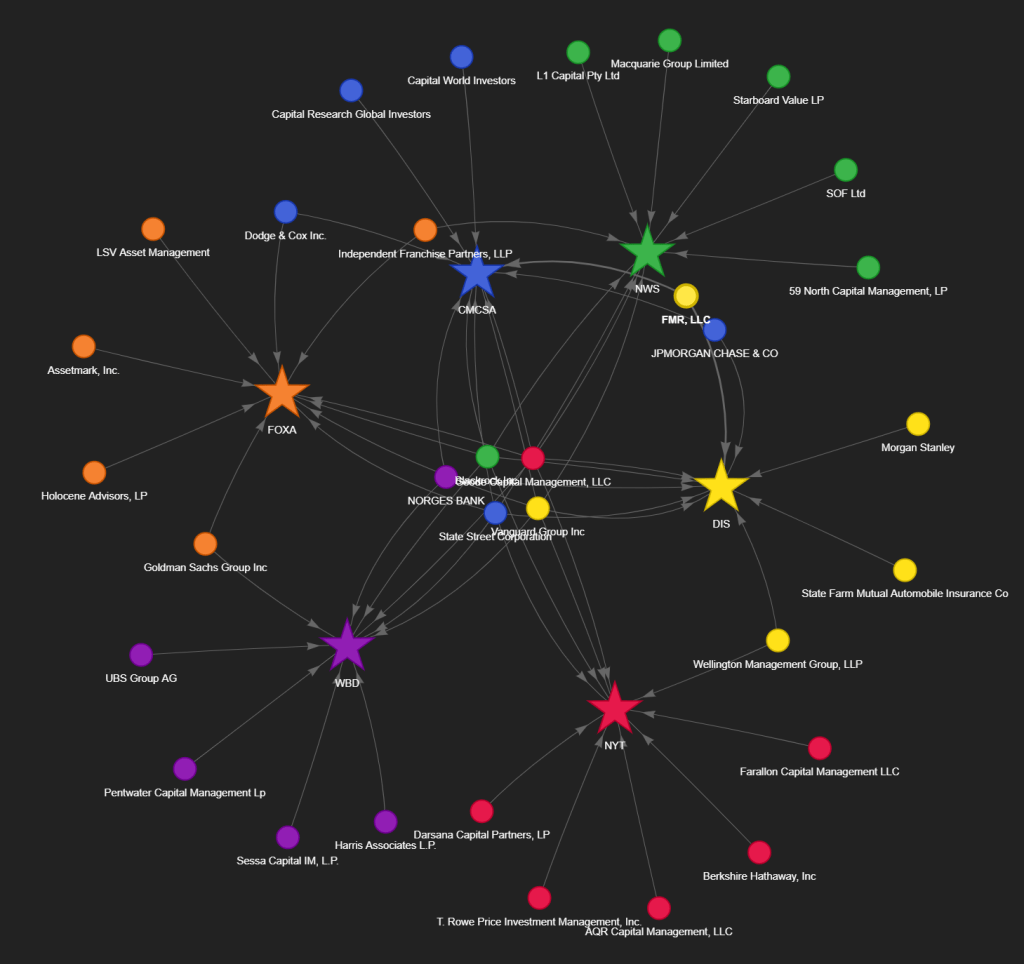
To empirically test this hypothesis, I analyzed the institutional ownership network of six major media conglomerates (NYT, NWS, FOXA, DIS, WBD, CMCSA). Using Python in Google Colab, I queried the yfinance API to extract the top 10 institutional holders for each company, compiling an edge list of 60 ownership ties. I then deployed the networkx library for modeling and PyVis to create an interactive HTML network graph [Chart 1] to visualize the multilateral relationships.
[Chart 1]
(Click the images to access interactive charts)
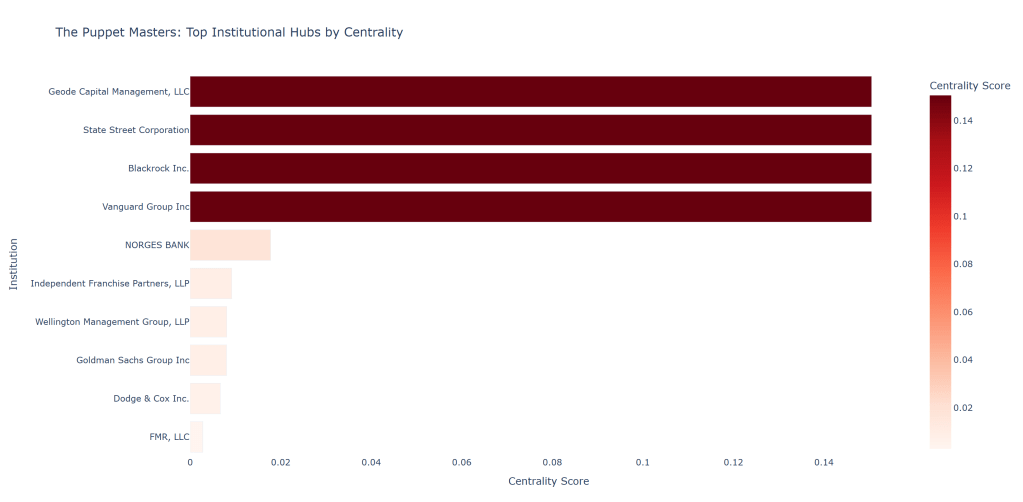
Initial degree analysis of the network graph revealed a striking concentration of capital. Out of a theoretical maximum of 60 distinct institutions, only 18 unique entities control these top positions. To identify the true power brokers, I calculated the Betweenness Centrality of a segmented undirected graph. The resulting power hierarchy bar chart [Chart 2] uncovered a striking phenomenon: The Vanguard Group and BlackRock act as the absolute super-hubs of this media web. Vanguard, BlackRock, State Street, and Geode Capital Management got the highest centrality score (0.1505).
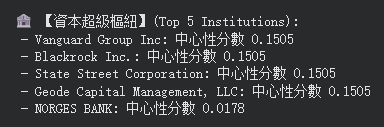
This statistical evidence suggests that four financial institutions sit at the most critical choke point of cross-media ownership, wielding unparalleled structural influence over the information network.
[Chart 2]
(Click the images to access interactive charts)
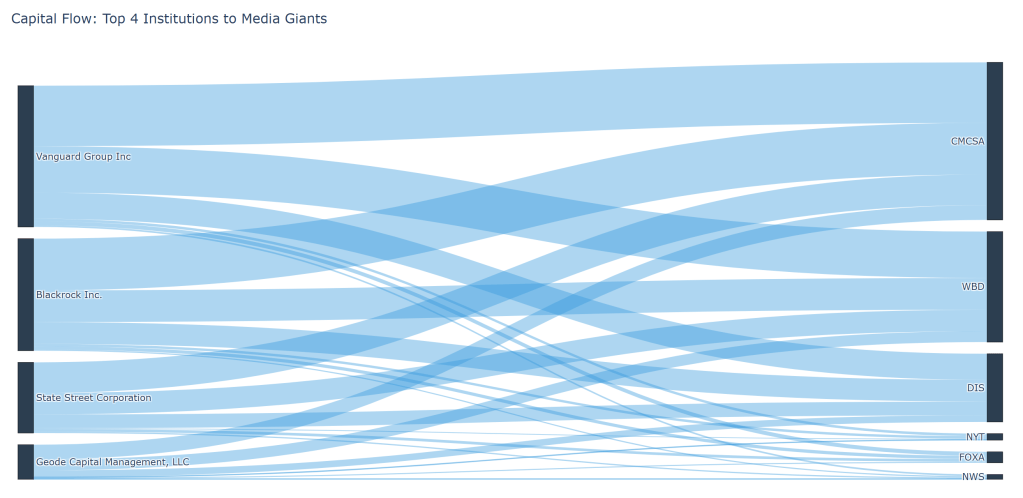
However, network topology only illustrates the existence of connections, not their financial magnitude. Shifting the analytical focus to the actual capital flow, I generated a Sankey diagram [Chart 3] using Plotly to track the exact share volume from the top four institutions to the six media targets. This visualization highlights how massive capital is deployed as weight. The thick flow lines demonstrate that the dominance of Vanguard and BlackRock is not merely structural but backed by overwhelming equity volume, providing them the capacity to heavily influence corporate governance across competing media factions.
[Chart 3]
(Click the images to access interactive charts)
However, a primary limitation of this study is the interpretative leap between capital ownership and editorial control. While SEC Form 13F filings empirically map the concentration of ‘Smart Money’ across the media landscape, these equity ties do not constitute direct evidence of coordinated influence on journalistic independence. In modern finance, mega-institutions like Vanguard often employ passive investment strategies, prioritizing portfolio returns over corporate governance. Furthermore, mainstream media organizations typically maintain rigorous ‘editorial firewalls’ to separate business interests from newsrooms. Therefore, while our network reveals an oligopolistic ownership structure, it cannot be used to conclude that these shared shareholders actively diminish market competition or compromise the diversity of media discourse.
To conclude, while the public perceives a diverse media landscape, the underlying equity structure is heavily centralized. Future research should expand the node size and incorporate proxy voting records to better reveal whether this concentrated wealth actively drives media hegemony or simply represents passive index investing.
Colab Link: https://colab.research.google.com/drive/1rJVvO-mdyFE-Ou6bwUfaMrd8DRtnRpMU?usp=sharing
 Previous Works